
Hey there—Katy here.
When we step into 1618 London in fiction, it’s easy to see the mud, the nooses and the narrow streets. It’s harder to feel the weight of a water bucket in cold hands, or smell the smoke in a woman’s hair as she leans over her hearth.
Most homes were full of children, apprentices, or both. The work of raising children deserves its own post, so today we’ll walk beside one woman—a housewife in 1618 London—and let her show us what one ordinary day might be like.
She could be the woman, the heroine in my series On The Wings Of Angels, Elizabeth Bowmar, meets at the pump, or the neighbor who presses a loaf into a hungry child’s hands and trusts God to make tomorrow’s dough stretch.
Dawn to Dusk: A Housewife’s Daily Routine
Our housewife wakes before the sun has much courage.
The room is as cold as the water in the pitcher she splashes on her face. She reaches for her gown and coif by habit more than sight, then kneels on rough floorboards to murmur her prayers—giving thanks for another day, and asking that no one in the household fall ill before nightfall.
If she is fortunate, a sleepy servant girl stirs, ready to help. If not, the work is hers alone. Before there is any talk of breakfast, she must:
– Tease yesterday’s embers into a living glow, or lay a new fire on the grate.
– Lift the lid on the water tub and judge whether someone must hurry to the conduit or pump.
– Look in on children, if she has them, and on any apprentices or servants if her husband keeps a trade.
Beyond her stretches a day of cooking, cleaning, mending, bargaining, smoothing quarrels, and keeping the fragile peace of a household. There is no eight‑hour shift and no clocking off. Her day begins with the first gray light and only truly ends when she banks the fire and whispers her last prayers in the dark.
Water, Fire, Bread—and Small Beer
For our 1618 housewife, water, fuel, bread and drink are not abstractions. They are the first arithmetic of every morning. Without them, nothing else in the day can happen.
Fetching water
Not every house has a convenient pump in the yard or a pipe into the kitchen. In many streets, water must be fetched from a public conduit, a parish pump, or a shared well.
Perhaps she sends a sturdy child with wooden buckets, or a servant with a shoulder‑yoke and dangling pails. In poorer homes, the housewife herself goes—skirt hem pinned up out of the mud, hands and shoulders already aching at the thought of the weight she’ll carry home.
A slip on a frosty morning can mean more than bruised knees. It can mean lost time, spilled water, and sharp words waiting at the door.
In some parishes, she doesn’t risk the slippery street at all, but pays a professional water carrier—‘cob’, a man licensed to haul water from the city conduits. He trudges his route with a heavy wooden tankard on his shoulder or two tubs slung from a yoke, pausing at each door to tip his burden into the waiting household bucket, selling each load for a few precious coins.
Fueling the hearth
Fuel is coin turned to heat and food.
She may burn:
– Wood—familiar, with a sweeter smoke, but increasingly expensive near London.
– “Sea coal”—mineral coal shipped down from the north, notorious for its thick, sooty smoke.
– Charcoal or other coal, where she can obtain it, each with its own price and smell.
Sea coal is cheap compared to good timber, and its black dust clings to everything. Smoke darkens beams, settles on linens, stings the eyes and throat. It also keeps her family warm and her pottage hot.
Much of the coal she buys comes in sacks, lugged and measured by coalmen. Now and again, a seller who cheats his customers—shorting the sacks, skimping on weight—finds himself in the pillory, displayed to his neighbors for false measures. It is a warning everyone understands: if you cheat, you will be shamed.
Our housewife keeps a shrewd eye on the scale when she can. When she cannot, she prays that this time, at least, the measure is honest.
Bread and the baker’s oven
She might bake small loaves in a heavy iron pot or an oven built into the chimney, if her kitchen has one. But in crowded London, many families rely on professional bakers’ ovens.
The city recognizes two great brotherhoods of bread:
– Brown bread bakers, with their coarse, darker loaves.
– White bread bakers, whose fine wheaten bread and manchets grace the tables of the better‑off.
A housewife like ours may:
– Buy ready‑baked loaves at dawn or as the purse allows.
– Or carry her own carefully kneaded dough to the baker’s oven, paying a fee to have it baked.
Whichever path she takes, keeping the household in bread is one of her most constant cares. A day without bread is a day that feels half‑starved, even if the pot is full of pottage.
Small beer on the table
When we hear “beer,” we often think of an evening drink, a treat after work.
In 1618, small beer was closer to food than a luxury. Brewed from grain and water like stronger ale but drawn off weak, it is:
– Safer than many water sources.
– Filling enough to count as part of a laborer’s diet.
– Mild enough for children and workers to drink all day.
Many London housewives brew small beer at home in modest batches. They manage malt, water and boiling time between scouring pots and soothing colicky babies. Some buy barm—the froth of yeast skimmed from commercial brews—from city brewers to start their own fermentation. Others inherit a precious bit of yeast from a neighbor’s last successful batch.
Our housewife may begin her day by lifting the lid on a small cask: is last week’s brew still sound? Has the yeast taken? Does she need to set another small barrel going while the morning is yet young?
Cleaning Hearth and Home: Smoke, Coal and Soot
Her labor is written in soot and ash and sore hands.
The fireplace
The hearth is the warm, smoky heart of the home. It:
– Heats the room where everyone gathers.
– Boils the pottage that will simmer for hours.
– Warms water for laundry and the endless round of washing.
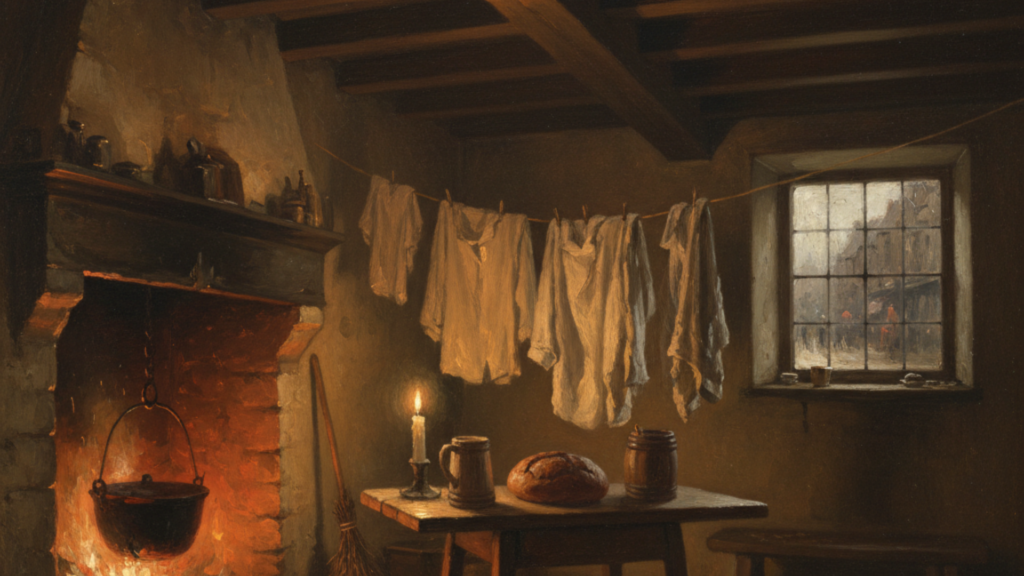
Some women hire laundresses to shoulder part of the burden, especially in larger households. Others do it all themselves. Bed linen is stripped and folded, then worked in tubs of hot water and soap, rinsed, and wrung until arms tremble. On clear days, sheets and shirts hang over bushes to dry; when the weather turns, they drape from beams and chairs, a forest of damp cloth that must not touch the sooty floor.
Each morning, someone—our housewife or a servant—rakes out the ash, saves any sound cinders, and lays fresh fuel. Sea coal and other coals throw off a constant grit that blackens walls and creeps into lungs. Charcoal or wood burn cleaner, but the cost nips at the family’s heels.
Windows, glass, and sconces
If her home is blessed with glass windows, the panes are small, set in lead, and dearly bought. Smoke from inside and filth from the street outside soon dimmed their light.
In poorer houses, the window panes are small and greenish, pitted and wavy, so that the street beyond swims and blurs as if seen through shallow water; light comes in, but never cleanly. In wealthier rooms, the glass is clearer and more even, catching the daylight in a bright, sharp sheet that shows every speck of dust in the air and lets a woman see the expression on a passer‑by’s face instead of just their shadow.
Now and again, as time allows, she wipes them down, cloth in hand, one foot braced on a bench or chest. Clearer glass means more daylight and less costly candle flame.
Her wall sconces and lanterns need the same attention. Light is expensive. In a middling household she might have:
– Tallow candles, which smoke, smell, and drip greasy tears.
She saves every stub of tallow candle in a little pot by the hearth, trimming the blackened wicks and dropping the waxy ends in with a practiced hand; when there are enough, she sets the pot in the warm ashes to melt and pours the greasy tallow around a fresh wick, buying herself a few more evenings of light without spending another penny.
– Lanterns that burn oil—nut oil where she can get it, fish or other lamp oils when she cannot.
Soot fogs the tiny glass panes and horn windows of these lanterns. Unless she wipes them free of their black coat, the light that seeps out is no better than a sulky glow.
Where does she obtain that oil? In London, grocers, chandlers and oilmen sell small measures of lamp oil, along with spices and other household necessities. Until only a year or so ago, the powerful Grocers’ Company also oversaw much of the trade in imported drugs and “cures.” In 1617, the apothecaries broke away to form their own company, changing where a woman might go when she needs both lamp oil and medicine in the same anxious afternoon.
A visit to one of these shops, squeezed in between tending the fire and stirring the pot, is another errand she must weigh against time and money.
Soap, Sweeping and Servants
Soap: bought and homemade
By 1618, soap‑boiling is a brisk and growing business. In the shops, a woman with a little coin to spare can lift a pale bar of imported Castile soap to her nose and catch a faint breath of oil and herbs, or choose English‑boiled soaps scented with lavender, rosemary or rose to sweeten the smell of skin and linen. If her purse is thin, she asks instead for the rough, brown household cakes meant for pounding shirts on the board and scouring stubborn grease from pots.
When there is no money at all, she makes do with what she can boil up herself: lye coaxed from water poured through wood ash, mixed with the saved scrapings of fat from the cooking pot. The result bites at her knuckles and fades cloth before its time, but it cuts the dirt. On washing days, that crude soap bubbles in a pot on the same fire that keeps the pottage simmering, while she stirs, sniffs, and listens with half an ear for quarrels in the yard and the unmistakable crash of something precious hitting the floor.
Sweeping, dusting, and never‑ending dirt
A 1618 London house is never truly clean.
Outside, streets are:
– Muddy when it rains.
– Dusty in dry spells.
– Always dotted with animal droppings, food waste, and the leavings of hundreds of feet.
Inside, every open doorway is an invitation for the city’s filth.
So she:
– Sweeps floors daily, sometimes overlaid with rushes or mats if the household can afford them, sometimes bare boards. Her broom is no neat modern brush, but a besom: a rough bundle of twigs or heather lashed tight around a wooden handle, bristles splaying and snapping with use. Each sweep sends up a small storm of dust and rush‑stems; the worn twigs scratching at the uneven boards as she drives yesterday’s street‑filth back out the door.
– Knocks dust from benches, stools and trestle tables.
– Beats bedding and bed curtains when there is time and space to do it.
If she has servants, she must train them, scold them, encourage them—and often redo their work. If she has none, the broom, the ash rake, and the washtub are all hers.
Dinner and Supper: The Heart of the Day
For many Londoners in 1618, dinner was the main meal, taken in the middle of the day when there was light and strength to enjoy it. Supper in the evening tended to be simpler and lighter.
But meals also obey the rhythm of work and guild.
In a craftsman’s household inside the city, the master, his wife, their children, apprentices and servants often eat together. Part of the master’s duty, as guilds understood it, is to care for the moral and spiritual growth of his apprentices. Meals are moments for that work.
They gather around the table, and someone—often the master or, in his absence, the mistress—says grace before and after. The words stitch together food, labor, and faith, reminding everyone in the room that what they eat is a gift and a responsibility.
Preparing the midday dinner
Our housewife has been thinking about dinner since she kneeled for her first prayer.
By mid‑morning, something must be:
—Bubbling in a pot: a thick pottage of peas or barley, with whatever vegetables are in season, perhaps bulked out with dried broad beans when money runs short and bellies are many.
—Perhaps joined by a piece of salted meat, or a rare piece of fresh meat, if the week has been kind.
On the table there will be bread—from a brown baker if money is tight, from a white baker if her husband wants to show his standing, or from dough she has kneaded and sent to the oven herself. There will be small beer in cups or mugs to wet dry throats and add a little strength for the afternoon’s work.
In some trades, the master can come home for dinner almost every day. In others, he may be called away—eating with fellow guild members, merchants, or clients. When he is present, his place at the table is a visible center to the household. When he is not, his wife still makes sure the apprentices and servants are fed, the grace said, and the talk kept within bounds.
Bread and who bakes it
Bread is simple, and it is also status.
– Coarse loaves from brown bread bakers sit on the tables of the poor and many steady working families.
– Fine, white loaves from the white bakers grace richer tables and special days.
Our housewife does her sums in bread:
– Can she stretch to white flour for Sunday or a feast day?
– Must she quietly swap to brown loaves this week and make up for hurt pride with a tasty pottage?
She may also keep back a little flour for small household loaves baked in her own pot, letting apprentices or children carry the rest as dough to the baker’s oven.
Supper and who comes home
By evening, the house is tired. So is she.
Supper is most often:
– Last night’s pottage, coaxed back to life over the coals.
– Cold meat, if there was enough at dinner.
– Bread and cheese.
– Perhaps a handful of fruit in season, or a scrap of something sweet saved from a better time.
Some husbands are reliably home by supper, especially in settled trades. Others linger in taverns, in guild halls, or at the bedsides of clients and patients. Our housewife cannot command his footsteps on the stairs, but she can keep back a little food when she dishes out to others, to be sure children and servants are fed even if he arrives late, cross, or empty‑handed.
When everyone is finally done, there may be a psalm, another grace, or a short reading from a Bible or chapbook, if the household owns one and someone can read aloud.
Worry, Hope, and Small Joys: Her Inner World
By the time she banks the fire at night, ash cool against the grate, our 1618 housewife is weary in muscle and in mind.
Her worries are close and practical:
– Will there be enough fuel to see out the winter?
– Will the coalman be honest next time, or will she be cheated by another light sack?
– Will her husband’s work hold steady, or will customers look elsewhere?
– Will sickness creep down their street and mark their door?
Yet even in the smoke and the strain, there is grace.
There is:
– The comfort of shared small beer and bread at a table that, for one more day, has been filled.
– Laughter at the conduit with another woman who understands exactly how heavy a water bucket feels at dawn.
– A lantern she has scrubbed bright, casting a clean, steady light on mending done well.
– A child’s warm head on her lap, or an apprentice’s awkward thanks for an extra crust.
For women my midwife heroine Elizabeth Bowmar meets in Sinful Oath, Book 1 of the On The Wings Of Angels Series, this daily grind is the ground on which faith and courage must stand. When justice fails, when guilds and courts and parishes look away from the vulnerable, it is often women like this—housewives with tired hands and steady hearts—who quietly keep others alive.
Their lives were not simple. But they were rich in texture, courage, and grace.
Thank you for joining me on this journey through a woman’s life in 1618 London. If you would like to learn of other posts like this, please sign up for my newsletter here.
Sources Behind This Post
If you’d like to read some of the scholarship that underpins posts like this, here are a few of the works I draw on when building 1618 London:
– Alice Clark, The Working Life of Women in the Seventeenth Century (1919).
– Ian Mortimer, The Time Traveler’s Guide to Elizabethan England (for everyday life slightly earlier, much of which carries forward).
– Paul Griffiths, Lost London: Change, Crime and Control in the Capital City, 1550–1660.
– Laura Gowing, Domestic Dangers: Women, Words and Sex in Early Modern London.